
Video lessons
Free LSAT video lessons
Short lessons from teachers on YouTube, chosen for the current test and sorted by the same question families and tasks as our practice. Watch one, then practice the skill it teaches.
Last checked
These videos are by independent teachers and prep companies. Think Clearly Prep is not affiliated with them or with LSAC, and they do not endorse this site.
Logical Reasoning
Conclusions and Disputes
Questions that ask what an argument is trying to prove, or what two speakers disagree or agree about. Finding the conclusion is the first step on almost every Logical Reasoning question, so start here.

Identifying the conclusion
Khan Academy LSAT on YouTube
- 6 min
- Captions
A short lesson from Khan Academy's official LSAT prep series on one way to find what an argument is trying to prove. Watch it before any other Logical Reasoning lesson.
Watch on YouTube: Identifying the conclusion
Questions about a dispute
Khan Academy LSAT on YouTube
- 7 min
- Captions
Shows one way to approach questions about two speakers who disagree. Useful for point-of-disagreement and point-of-agreement questions.
Watch on YouTube: Questions about a dispute
Assumptions
Necessary assumption questions ask what an argument depends on; sufficient assumption questions ask what would make its conclusion follow. Both start with the gap between the evidence and the conclusion.
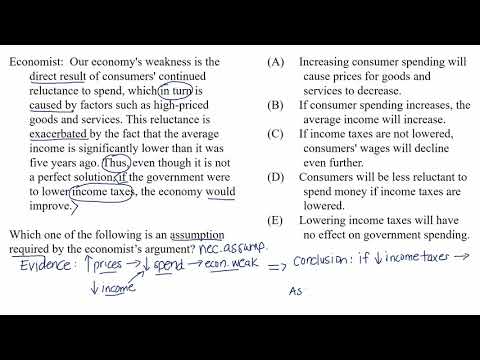
Necessary assumptions
Khan Academy LSAT on YouTube
- 9 min
- Captions
Khan Academy's lesson on questions that ask what an argument needs in order to work. Watch it if assumption answers feel like guesses.
Watch on YouTube: Necessary assumptions
Necessary versus sufficient assumptions
LSAT Unplugged & Law School Admissions Podcast on YouTube
- 7 min
Contrasts the two assumption tasks, which call for different kinds of answer. Watch it after the necessary assumption lesson and before you drill sufficient assumption questions.
Watch on YouTube: Necessary versus sufficient assumptions
Strengthen or Weaken
Pick the answer that makes an argument more or less convincing, or the question whose answer would help you judge it. The right answer only has to move the argument, not prove or destroy it.

Weakening an argument
Khan Academy LSAT on YouTube
- 10 min
- Captions
Khan Academy's lesson on choosing the answer that weakens an argument. Pair it with a timed set of weaken questions.
Watch on YouTube: Weakening an argument
Strengthen and weaken, side by side
LSAT JP on YouTube
- 9 min
A short set of tips that covers both strengthen and weaken questions. A good refresher once you know the basic approach.
Watch on YouTube: Strengthen and weaken, side by side
Flaws
Describe what is wrong with the reasoning. Flaw questions are the most common Logical Reasoning family, and the same errors come back again and again.

Describing a flaw
Khan Academy LSAT on YouTube
- 8 min
- Captions
Khan Academy's lesson on how to approach questions that ask you to describe an error in an argument's reasoning.
Watch on YouTube: Describing a flaw
The flaws that keep coming back
LSAT Lab on YouTube
- 25 min
- From an LSAT prep company
A longer lesson on the reasoning errors that appear again and again in flaw answer choices. Watch it to build a working list of flaws before you drill this family.
Watch on YouTube: The flaws that keep coming back
Matching Flaws
Find the answer whose argument makes the same mistake as the stimulus. Name the flaw in the stimulus before you read the answers.
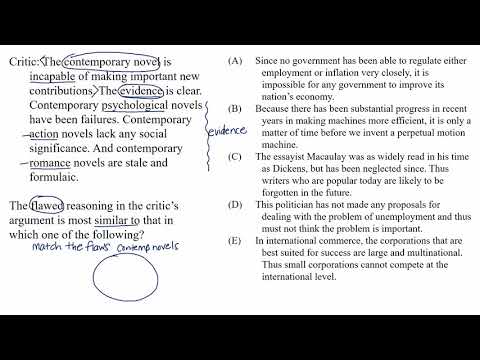
Matching flaws
Khan Academy LSAT on YouTube
- 8 min
- Captions
Khan Academy's lesson on finding the answer whose reasoning makes the same error as the stimulus.
Watch on YouTube: Matching flaws
A parallel flaw question, worked through
Khan Academy LSAT on YouTube
- 8 min
- Captions
A worked example of a parallel flaw question. Watch it after the lesson to see the approach applied to a full question.
Watch on YouTube: A parallel flaw question, worked through
Matching Structure and Principles
Match the pattern of an argument, or apply a general rule to a specific case. Describe the structure or principle in plain, abstract terms before you compare answers.
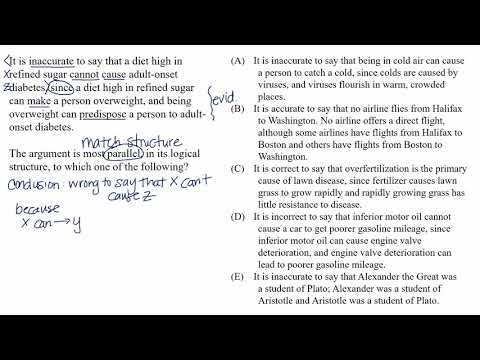
Matching an argument's structure
Khan Academy LSAT on YouTube
- 8 min
- Captions
Shows one way to find the answer that has the same argument structure as the stimulus.
Watch on YouTube: Matching an argument's structure
Matching a principle
Khan Academy LSAT on YouTube
- 6 min
- Captions
Shows one way to approach questions that ask which statement reflects a principle from the stimulus.
Watch on YouTube: Matching a principle
Deductions and Inference
Decide what must be true, or what is most strongly supported, using only the statements you are given. The right answer stays inside what the facts allow.

What must follow from the statements
Khan Academy LSAT on YouTube
- 9 min
- Captions
A lesson on questions that ask what follows logically from a set of statements. Watch it if you tend to pick answers that go one step beyond the facts.
Watch on YouTube: What must follow from the statements
Most strongly supported
Khan Academy LSAT on YouTube
- 6 min
- Captions
Shows one way to approach questions that ask which statement the stimulus most strongly supports. Watch it after the previous lesson to see how the two tasks differ.
Watch on YouTube: Most strongly supported
Explain or Resolve
Two facts seem to conflict, and the right answer shows how both can be true. Keep both facts in view and look for the difference that reconciles them.

Explaining a discrepancy
Khan Academy LSAT on YouTube
- 6 min
- Captions
Khan Academy's lesson on questions that ask you to explain an apparent discrepancy between two facts.
Watch on YouTube: Explaining a discrepancy
A four-step method for paradoxes
LSAT Unplugged & Law School Admissions Podcast on YouTube
- 5 min
Sets out a four-step process for resolving a paradox, using an everyday example, and warns about answers that distort the facts.
Watch on YouTube: A four-step method for paradoxes
Techniques, Roles, and Principles
Describe how an argument works: the method it uses, the role a statement plays, or the principle behind it. These questions reward reading the structure rather than the topic.

Identifying the technique
Khan Academy LSAT on YouTube
- 7 min
- Captions
Shows one way to approach questions that ask how an argument proceeds, that is, the method of reasoning it uses.
Watch on YouTube: Identifying the technique
The role a statement plays
Khan Academy LSAT on YouTube
- 6 min
- Captions
A worked example of a question that asks what role a particular statement plays in an argument.
Watch on YouTube: The role a statement plays
Conditional logic
If, only if, unless, all and none: the language of rules. Conditional reasoning runs through several Logical Reasoning families, and confusing a rule with its reverse is one of the most fixable errors.

Conditional logic from the ground up
7Sage LSAT Prep & Law School Admissions Consulting on YouTube
- 34 min
- From an LSAT prep company
A complete walkthrough of conditional reasoning: sufficient and necessary conditions, contrapositives, the words "only if" and "unless", chaining and diagramming. It is long, so watch it in two sittings if you need to.
Watch on YouTube: Conditional logic from the ground up
If, only if and unless
Blakely S. Moore on YouTube
- 12 min
Explains how to read statements built on if, only if, unless and if and only if. Watch it if you keep choosing the reversed rule.
Watch on YouTube: If, only if and unless
Reading Comprehension
Reading and mapping a passage
How to read a passage for its structure: the main point, the viewpoints, and what each paragraph does. A good first read makes every question faster.

Working through a humanities passage
Khan Academy LSAT on YouTube
- 9 min
- Captions
A demonstration of one way to read and work through a humanities passage, from the first read to the questions.
Watch on YouTube: Working through a humanities passage
Reading for structure when your focus drifts
LSAT Unplugged & Law School Admissions Podcast on YouTube
- 30 min
- Captions
A long lesson on reading passages for their structure and signal words, aimed at students who lose focus partway through a passage.
Watch on YouTube: Reading for structure when your focus drifts
Main point questions
Questions about a passage's main point or primary purpose. The right answer covers the whole passage, not just one paragraph.

A main point question, worked through
Khan Academy LSAT on YouTube
- 4 min
- Captions
A short example of a main point question on a humanities passage.
Watch on YouTube: A main point question, worked through
Finding the main point
LSAT Demon on YouTube
- 10 min
- From an LSAT prep company
A lesson on finding the main point of a Reading Comprehension passage. Watch it if main point questions send you back to reread the whole passage.
Watch on YouTube: Finding the main point
Detail and inference questions
Detail questions ask what the passage says; inference questions ask what it implies. Both are answered from the text, so go back and check before you choose.

A detail question, worked through
Khan Academy LSAT on YouTube
- 3 min
- Captions
A short example of a recognition question, the kind that asks what a science passage actually says.
Watch on YouTube: A detail question, worked through
Inference questions in Reading Comprehension
LSAT Lab on YouTube
- 31 min
- Captions
- From an LSAT prep company
A longer lesson on inference questions: the different ways a correct answer can be implied, and the common trap answers.
Watch on YouTube: Inference questions in Reading Comprehension
Function questions
Why does the author mention this, and how is the passage put together? Function questions ask about the job a word, example or paragraph does.

Why the author mentions it
Khan Academy LSAT on YouTube
- 5 min
- Captions
A worked example of a question about the purpose of a reference in a law passage.
Watch on YouTube: Why the author mentions it
How the passage is organized
Khan Academy LSAT on YouTube
- 4 min
- Captions
A short example of a question about how the information in a science passage is organized.
Watch on YouTube: How the passage is organized
Author attitude
What does the author think, and how strongly? Attitude questions turn on word choice, so notice the difference between cautious approval and enthusiasm.

Inferring attitudes
Khan Academy LSAT on YouTube
- 3 min
- Captions
A short example of a question that asks you to infer attitudes from a social science passage.
Watch on YouTube: Inferring attitudes
The author's intent
LSAT Lab on YouTube
- 29 min
- Captions
- From an LSAT prep company
A longer lesson on question types that test the author's meaning and rhetorical strategy: what the author thinks and why the passage is written the way it is.
Watch on YouTube: The author's intent
Comparative passages
A Reading Comprehension set may use two shorter passages instead of one long one. The questions ask how the passages relate, where they agree and where they part ways.

A comparative pair, worked through
Khan Academy LSAT on YouTube
- 12 min
- Captions
An example of one way to approach a pair of comparative passages about law.
Watch on YouTube: A comparative pair, worked through
Comparative passages and relationship questions
LSAT Lab on YouTube
- 44 min
- Captions
- From an LSAT prep company
A full lesson on comparative passages, focused on questions about how the two passages relate. At about 44 minutes, it is the deepest dive in this list.
Watch on YouTube: Comparative passages and relationship questions
Method
Timing and pacing
Each section gives you 35 minutes for roughly 25 to 27 questions. These lessons cover pacing, flagging a hard question and moving on, and reaching the last Reading Comprehension passage.

Getting faster at Logical Reasoning
LSAT Unplugged & Law School Admissions Podcast on YouTube
- 5 min
Covers time per question, flagging hard questions to come back to, and why Logical Reasoning carries more weight in the current format.
Watch on YouTube: Getting faster at Logical Reasoning
Reaching the fourth passage
LSAT Demon on YouTube
- 12 min
- From an LSAT prep company
Answers a student who runs out of time in Reading Comprehension, with a reading pace that invests time early and speeds up through the passage.
Watch on YouTube: Reaching the fourth passage
Blind review and the study cycle
Blind review means re-answering the questions you were unsure of, untimed and before you check the key. Paired with an error log, it turns each practice test into a lesson.

Three ways to blind review
Scott Miller Coaching on YouTube
- 16 min
Explains what blind review is and three ways to run it after a practice test. Watch it before your first full-length test.
Watch on YouTube: Three ways to blind review
Keeping a wrong-answer journal
Whitney’s Verdict on YouTube
- 9 min
A test taker shows how they kept a wrong-answer journal while studying. The same habit is what the simulator's error log is for.
Watch on YouTube: Keeping a wrong-answer journal
Writing
Argumentative Writing
The writing task gives you 15 minutes of prewriting analysis and 35 minutes to write an essay that takes a position on a debatable issue. It is unscored, but it is required and law schools can read it.

Approaching Argumentative Writing
LSAT Unplugged & Law School Admissions Podcast on YouTube
- 6 min
A short overview of the Argumentative Writing task that replaced the old writing sample in 2024, and how to approach it.
Watch on YouTube: Approaching Argumentative Writing
Keep the essay simple
LSAT Demon on YouTube
- 7 min
- From an LSAT prep company
Advice to write plainly, in short sentences that stick to the facts. The essay is unlikely to make an application, but a careless one can hurt it.
Watch on YouTube: Keep the essay simple
The test
Format, scores and test day
What is on the test now, how the 120 to 180 score works, and what test day looks like. Rules can change between testing cycles, so confirm the details for your own test in your LSAC account.

The LSAT in 2026: an overview
Dhairya Khara on YouTube
- 10 min
Covers the sections, including the unscored one, the flow of test day, how scores and percentiles work, Argumentative Writing, and when to test.
Watch on YouTube: The LSAT in 2026: an overview
What changed for 2026
LSAT Unplugged & Law School Admissions Podcast on YouTube
- 6 min
Covers recent changes to the test, including the move back to in-person test centers, and why older prep information online can mislead you.
Watch on YouTube: What changed for 2026
How we choose the videos
- Current format only. Nothing on Logic Games, which left the test in August 2024, and nothing that teaches the older format as current.
- Many lessons come from the free LSAT series Khan Academy made with LSAC in 2018. The Logical Reasoning and Reading Comprehension question types they teach did not change in 2024.
- Every video is public, can be played on other sites, is in English and runs 3 to 45 minutes. We prefer captioned lessons.
- Lessons from a prep company's own channel are labeled. We link to them only where they explain a skill best.
- The titles and summaries on this page are ours. Each video belongs to its creator. We check the list for removed or changed videos before every site update.
For official material, start with LSAC's LSAT pages and its free practice on LawHub. Thumbnails on this page load from YouTube's image server, and a player loads only when you press play; see ourprivacy policy.
Practice what you watched
The free diagnostic shows which families cost you points, and every answer choice comes with an explanation. In review, each question links back to the matching lesson here.